Abstract
Can buyers of second-hand branded products alter them and resell their creations while keeping the logos and monograms visible? In the Louis Vuitton–Kamad Reworked case, the Paris Judicial Court distinguished the resale of genuine products from the marketing of new goods made from their materials, holding that the exhaustion of trade mark rights did not apply to the latter.
In its judgment of 17 September 2026, the court of first instance ordered the company and its directors to pay Louis Vuitton €920,000 in damages. Neither the authenticity of the materials, nor the stated environmental objectives, nor the information provided to purchasers justified the conduct at issue. This article examines the reasons behind the decision and the legal limits to consider before transforming and reselling branded products.
What upcycling practice did Louis Vuitton challenge?
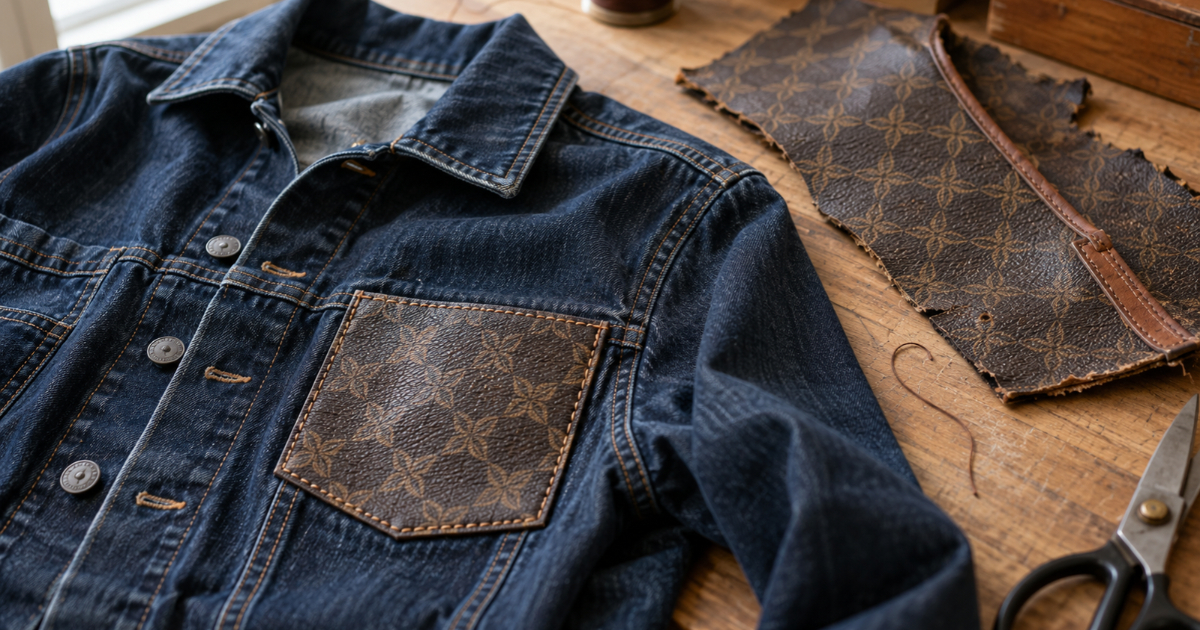
A handbag can become part of a jacket. Buttons from an old garment can be turned into earrings. That is the principle behind upcycling: recovering existing products or materials and giving them new value by making new objects. It combines creativity with reuse and is particularly appealing in fashion, where fabrics, components and accessories can retain value even when the original item is no longer used.
But when those materials display a recognisable trade mark, the transformation raises another question: does buying the original item also entitle the purchaser to use the mark appearing on it to sell a new creation?
We have already addressed this issue in the article Upcycling and branded products: when resale becomes risky, starting from a dispute involving Hermès. The Louis Vuitton case now allows us to examine the question further, in a dispute where the authenticity of the materials did not prevent a finding of infringement.
In its judgment of 17 September 2026 (Case No. 24/07925), the Paris Judicial Court examined the activities of Kamad Reworked, which cut panels from genuine Louis Vuitton products and incorporated them into clothing and accessories on which the fashion house’s trade marks remained visible.
The decisive passage in the court’s reasoning concerns precisely the selection of those pieces. According to the judges, Kamad intended to use:
“not the material as such, but the distinctive signs it bears.” Source: Louis Vuitton judgment
The recovery of materials thus also became a means of exploiting the trade mark’s commercial appeal.
Why is it trade mark infringement if the materials are authentic?
A person who buys a genuine product can normally resell it. This follows from the principle of exhaustion of trade mark rights: once goods have been placed on the market in the European Economic Area by the trade mark proprietor or with its consent, the proprietor’s exclusive right to control their subsequent circulation is limited. This is provided for in Article 15 of Regulation (EU) 17/1001.
In the Kamad case, the court examined records of purchases made through auctions and second-hand platforms and considered them sufficient to establish that the original products had been marketed in the European Economic Area with Louis Vuitton’s consent.
The difficulty arose at the next stage. Kamad cut up those products and incorporated parts of them into new garments and accessories. As the judges explained:
“the products into which the inserts were incorporated, and on which the disputed signs are now used, are not the products placed on the market by LVM.” Source: Louis Vuitton judgment
For that reason, the court ruled that exhaustion did not apply, without examining the further arguments concerning legitimate grounds for opposing resale.
Consent to the marketing of the original product therefore did not extend to the sale of the new goods created by Kamad. Although the trade marks came from genuine materials, they were being used on goods that Louis Vuitton had neither placed on the market nor authorised.
This conclusion, however, calls for a qualification. Replacing a handbag’s zip, decorating its surface and cutting it up to make inserts for several jackets are different types of intervention. They differ in their purpose, the degree of continuity with the original product and the role played by the trade mark in the finished item. The distinction between repair, customisation and the manufacture of new goods must therefore be assessed on the basis of what has actually been done.
Even where the product retains its identity, the right to resell it may still be subject to limits. Article 15 itself permits the proprietor to oppose further commercialisation where legitimate reasons exist, particularly where the condition of the goods has been changed or impaired.
It is therefore necessary to assess both which product is being put back on the market and the effects of the changes made to it. Proving that the original item was genuinely purchased is a starting point; it does not, in itself, establish that its alteration and resale are lawful.
Can an environmental objective justify using someone else’s trade mark?
Recovering existing materials can reduce waste and extend their useful life. But can an environmental benefit justify use of a trade mark without its proprietor’s authorisation? The Paris Judicial Court expressly addressed this question in the Kamad case.
The court began by noting the absence of any specific exemption for this activity:
“No provision of EU or national legislation provides that upcycling justifies restricting intellectual property rights.” Source: Louis Vuitton judgment
The court then moved from the legal framework to the products actually used. Kamad’s documented purchases concerned items that could still be sold on the second-hand market. In the judges’ view, destroying those items to extract fragments removed goods from that market, thereby stimulating demand for new products. The court’s conclusion was unequivocal:
“The infringement of LVM’s trade mark rights therefore pursues a profit-making purpose, not environmental protection.” Source: Louis Vuitton judgment
This part of the reasoning warrants critical examination. An activity can be profitable and still deliver environmental benefits. Moreover, the fact that a second-hand item could be resold does not automatically establish that transforming it would be less sustainable. A comparison of the alternatives would need to consider the lifespan of the new product, the resources used in processing it and the purchases that its use might replace.
The judgment, however, contains a further argument. The court also considered the assumption most favourable to Kamad:
“Even assuming that environmental protection was the main objective pursued […] the infringement of LVM’s rights, for which authorisation was not even sought, would be disproportionate.” Source: Louis Vuitton judgment
The omitted passage refers to the remaining economic value of the products and the possibility of reselling them in their original condition.
The judgment therefore does not suggest that upcycling has no environmental value. Rather, it rejects Kamad’s justification in light of the specific characteristics of the activity examined. For anyone planning a sustainable collection, the practical questions remain: what benefit does the transformation deliver, and under what conditions may the trade marks on the recovered materials be used?
Does using your own brand and certificates of authenticity make resale lawful?
Anyone transforming a branded product may think that any ambiguity can be avoided by displaying their own name, explaining that the materials have been recovered and documenting their authenticity. But knowing who made an object does not rule out the possibility that consumers will assume a collaboration with the original brand.
This was one of the issues raised in the Louis Vuitton case. The court observed that consumers will not necessarily read the label or product description. On seeing the fashion house’s signs on a garment, they may believe:
“that the product is marketed by LVM or, at the very least, that there is a connection between LVM and KR.” Source: Louis Vuitton judgment
The court explained that this connection might be understood as a collaboration or as prior verification of the authenticity of the materials used.
The designation “Kamad Paris” therefore identifies the party offering the creation, but the presence of Louis Vuitton trade marks may suggest an additional commercial relationship. The word “upcycled” describes the transformation; it does not necessarily clarify whether that transformation was authorised.
The court also considered the exploitation of the marks’ reputation and the harm caused to trade marks with a reputation. The lawfulness of the activity does not depend solely on whether the buyer knows who made the product.
Certificates of authenticity raise a further issue. In the separate dispute between Chanel and Kamad, decided by the Paris Judicial Court on 21 May 2026 (Case No. 25/00621), the document supplied to purchasers even stated that there was no collaboration with the brands from which the materials originated. Nevertheless, the court observed that:
“by invoking the concepts of authenticity and originality, KR leads the average consumer to believe […] that the manufacture and marketing of the jewellery […] are lawful, when in fact they constitute infringement.” Source: Chanel judgment, p. 11
The provision of those certificates was therefore held to be a misleading commercial practice.
The key is to distinguish what each piece of information establishes. The origin of the materials, the identity of the person transforming them and authorisation to use the trade mark are separate issues. A certificate proving that a component is genuine does not amount to the trade mark proprietor’s consent to sell the new item. Communications to consumers must respect this distinction and avoid presenting the word “authentic” as a guarantee of lawfulness that it cannot provide.
What are the consequences of unlawful upcycling for a company and its directors?
In the Kamad case, Louis Vuitton was awarded €920,000 in damages: €750,000 for infringement of trade marks with a reputation, €10,000 for infringement of an additional figurative mark and €160,000 for unfair competition and parasitism. The defendants were also ordered to pay a total of €120,000 in legal expenses not included in the court costs, in addition to those court costs. Source: operative part of the Louis Vuitton judgment
The consequences for the business also included an injunction preventing the continuation of the challenged activities, destruction of the products identified in the judgment, removal of promotional content and publication of the judgment. These measures affect inventory, sales channels and business reputation, and are backed by penalty payments for failure to comply with the court’s orders.
The judgment also imposed personal liability on the company’s three directors. To understand why, it is necessary to consider the test applied by the court: misconduct separable from a director’s corporate functions, which must be:
“committed intentionally by the director, particularly serious in nature, and incompatible with the normal performance of corporate duties.” Source: Louis Vuitton judgment
The judges attached significance to the directors’ direct involvement in designing, organising and promoting the business, which continued even after Louis Vuitton raised its objections. The consequence was stated unambiguously:
“Their liability therefore extends to the full amount of the orders and penalty payments imposed on KR.” Source: Louis Vuitton judgment
Personal liability thus arose from the conduct established by the court, under the applicable principles of French law. Holding the position of director does not automatically make someone liable for a company’s unlawful acts. The judgment was delivered at first instance and is provisionally enforceable.
For anyone wishing to develop an upcycling business, legal due diligence must therefore form part of the project’s financial planning. Before buying materials and funding a collection, it is necessary to examine the provenance of the products, the proposed transformations, the visibility of trade marks and the way the finished goods will be presented to the public, while assessing whether any authorisations are required.
An invoice may prove that a genuine item was purchased. Before deciding to invest in it, however, it is equally important to understand the conditions under which the transformed product may lawfully be sold.
Reviewed by: Arlo Canella
Publication date: 2 November 2026
© Canella Camaiora S.t.A. S.r.l. - All rights reserved.
Textual reproduction of the article is permitted, even for commercial purposes, within the limit of 15% of its entirety, provided that the source is clearly indicated. In the case of online reproduction, a link to the original article must be included. Unauthorised reproduction or paraphrasing without indication of source will be prosecuted.

Margherita Manca
Avvocato presso lo Studio Legale Canella Camaiora, iscritta all’Ordine degli Avvocati di Milano, si occupa di diritto industriale.