Abstract
Upcycling consists of transforming existing products into new items, often with creative or sustainable purposes. However, when it involves branded products, reselling the modified item may interfere with trademarks and copyright. The principle of exhaustion allows the normal resale of the original product, but it may not apply if the product is altered and reintroduced to the market as a different good. In such cases, a green purpose is not enough: it is necessary to assess whether the value of the new product still depends on the trademark, design, or protected creative elements.
What is upcycling and why does it involve trademarks?
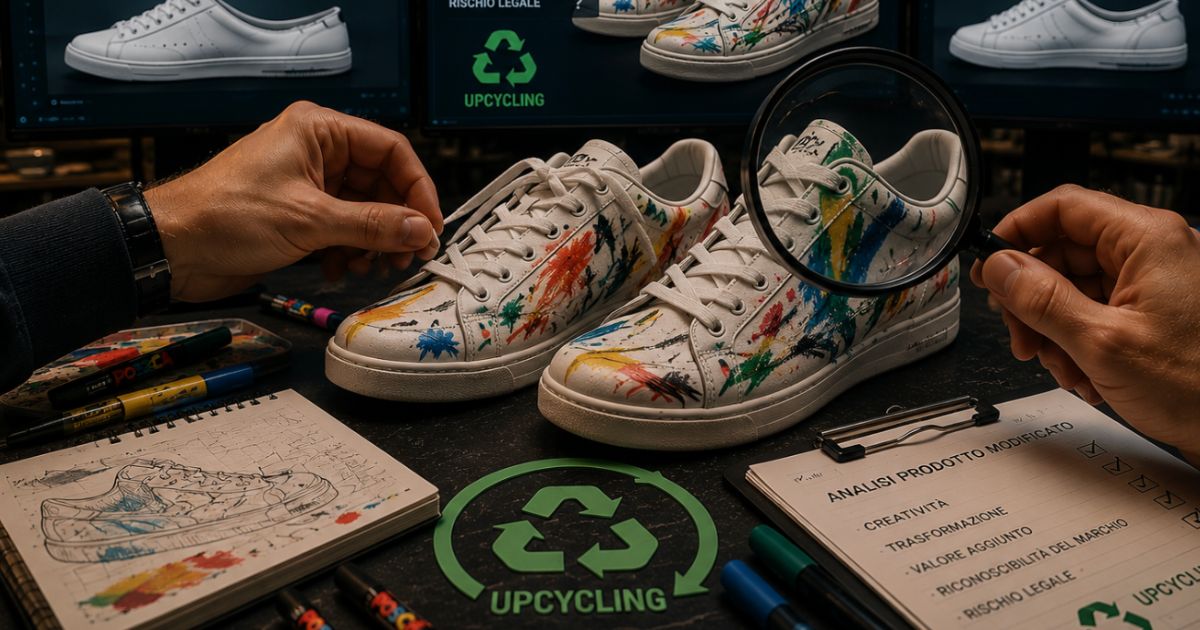
Upcycling is the creative transformation of existing products. It is not simple recycling: the product is not destroyed to recover raw materials, but rather modified, reinterpreted, and often resold as a new object.
It is an increasingly widespread practice, especially in fashion. It may involve bags, scarves, shoes, clothing, or accessories already placed on the market. However, when working on branded products, the issue also becomes legal: is it permissible to modify original products and then resell them?
The key point is this: reselling a used product is different from transforming it and placing it back on the market. An original bag or pair of shoes can be sold as second-hand goods. But if they are cut, assembled, or customized, the item is no longer the same as the one originally placed on the market by the brand.
This is where the problem arises. Upcycling often leaves the original product recognizable. This recognizability creates value, as consumers still perceive the link to the original brand or design. At the same time, however, it may lead them to believe that there is an official connection with the brand.
This is where legal risk emerges.
Upcycling of branded products: what are the legal limits?
From a legal perspective, the crucial step is the transformation of the product before resale. As long as an original product is resold as it is, the principle of trademark exhaustion normally applies: after the first authorized sale, the rights holder cannot prevent further circulation of that good (Art. 5 of the Italian Industrial Property Code).
However, this rule has a limit. If the product is modified before being reintroduced to the market, the rights holder may oppose further sale when legitimate reasons exist—particularly when “the condition of the goods is changed or altered after they have been put on the market.” (Art. 5 of the Italian Industrial Property Code).
In upcycling, therefore, the issue is not the ordinary resale of the original product. The problem is that, after transformation, a different product is placed on the market. This makes the defense based on simple resale of second-hand goods much weaker.
The same reasoning may apply to copyright. Fabrics, prints, and designs used in upcycling may be protected works by the Italian Copyright Law (Law No. 633/1941). In such cases, not only reproduction is relevant: the exclusive right to adapt or transform the work – reserved to the author – may also come into play (Art. 18 of the Italian Copyright Law).
As a result, even a creative intervention – such as reusing parts of a product to create a new one – may be considered a new use of the protected work.
Green purpose and brand rights: what do courts say?
Upcycling is often driven by sustainability goals: reusing existing products, reducing waste, and giving new life to materials already on the market. From a legal standpoint, however, a green purpose is not sufficient to exclude infringement of trademarks or copyright.
The principle is straightforward: an activity can be sustainable and still interfere with intellectual property rights. In the absence of a specific legal exception, the circular nature of the operation does not automatically authorize the transformation and resale of protected products.
This principle is illustrated by a case decided by the Judicial Court of Paris involving Hermès (10 April 2025, RG 22/10720). The case concerned jackets made using original Hermès scarves, presented as upcycled products.
The court acknowledged the creative and sustainable context but ruled that this was not sufficient to override the rights of the trademark owner. Transforming the original product and incorporating it into a new item may constitute an unauthorized new use, especially when the trademark or protected creative elements remain recognizable.
In Italy, there are not yet decisions specifically addressing upcycling. However, there are related cases that help clarify the courts’ approach. One example is an order issued by the Court of Milan on 25 July 2022 concerning the customization of original footwear.
In that case as well, the issue was the modification of a branded product and its subsequent resale. The judge excluded the application of the exhaustion principle, emphasizing that it does not apply when “the condition of the goods is changed or altered after they have been put on the market”.
While the cases are not identical, they point to a common line: when a product is transformed and resold, a creative or sustainable purpose does not eliminate the risk of legal challenges. The focus shifts to the actual outcome: how much the new product still depends on the trademark, design, or original work.
This question – more than any claim of sustainability – is decisive before selling modified products.
Selling modified products: what checks should be carried out beforehand?
The decisions examined suggest some practical criteria. Before selling modified products or starting an upcycling business involving branded goods, it is not enough to ask whether the operation is creative or sustainable. It is necessary to understand how much the final product still depends on the original trademark or work.
In the cases analyzed, courts emphasized that the original product had been modified and then sold as a different item: scarves turned into jackets, original footwear customized and resold as unique pieces.
If the value mainly derives from the new creation, the legal risk may be lower. However, if it still depends on the trademark, print, design, or recognizability of the original product, the likelihood of a dispute increases.
The way the product is presented to the public also matters. The use of the brand name, visibility of the trademark, photos, descriptions, and sales channels can all influence consumer perception. If consumers may believe there is an official connection with the trademark owner, the risk increases.
Upcycling branded products is therefore possible only within narrow limits. When the modified product is sold and continues to derive value from the original brand, the activity remains exposed to legal challenges. For this reason, it should be assessed before launching the business, not after it is already on the market and subject to disputes.
Reviewed by: Arlo Canella
Publication date: 15 May 2026
© Canella Camaiora S.t.A. S.r.l. - All rights reserved.
Textual reproduction of the article is permitted, even for commercial purposes, within the limit of 15% of its entirety, provided that the source is clearly indicated. In the case of online reproduction, a link to the original article must be included. Unauthorised reproduction or paraphrasing without indication of source will be prosecuted.

Margherita Manca
Avvocato presso lo Studio Legale Canella Camaiora, iscritta all’Ordine degli Avvocati di Milano, si occupa di diritto industriale.