
Abstract
The end of SIAE’s exclusive right to act as an intermediary in copyright management is the result of a process that unfolded in several stages. In 2017, the market was opened to other Collective Management Organisations (“CMOs”); in 2024, that opening was extended to Independent Management Entities (“IMEs”). The distinction between these categories is key to understanding both the significance of the EU Court of Justice’s judgment in LEA v Jamendo (Case C-10/22, arising from a request for a preliminary ruling from the Tribunale ordinario di Roma) and the approach adopted by the Italian legislature in Decree-Law No 131/2024.
The Barnier Directive and rightholders’ freedom of choice
Directive 2014/26/EU of 26 February 2014, commonly known as the “Barnier Directive”, governs the collective management of copyright and related rights and multi-territorial licensing for the online use of musical works. Its framework combines access across the European Union with safeguards for rightholders: rules on governance, financial management, transparency and supervision are intended to ensure reliable rights management services.
Article 5 gives rightholders the right to choose the CMO to which they entrust their rights, categories of rights or types of works, specifying the territories concerned, irrespective of the Member State of nationality, residence or establishment. The management entrusted to the CMO need only fall within the scope of its activities.
Recital 15 also envisages the possibility of choosing an independent management entity. However, the Directive distinguishes between the two models and, under Article 2(4), subjects IMEs to only some of its provisions.
It would therefore be inaccurate to suggest that all intermediaries recognised under EU law are subject to fully equivalent regulatory regimes.
CMOs and IMEs are distinct legal categories
The terms used in the legislation are “collective management organisations” and “independent management entities”. These are two categories of intermediaries subject to different legal regimes. Both types of entities manage rights on behalf of more than one rightholder, for the collective benefit of those rightholders, as their sole or main purpose. They differ in their possible ancillary purposes and, in particular, their structure.
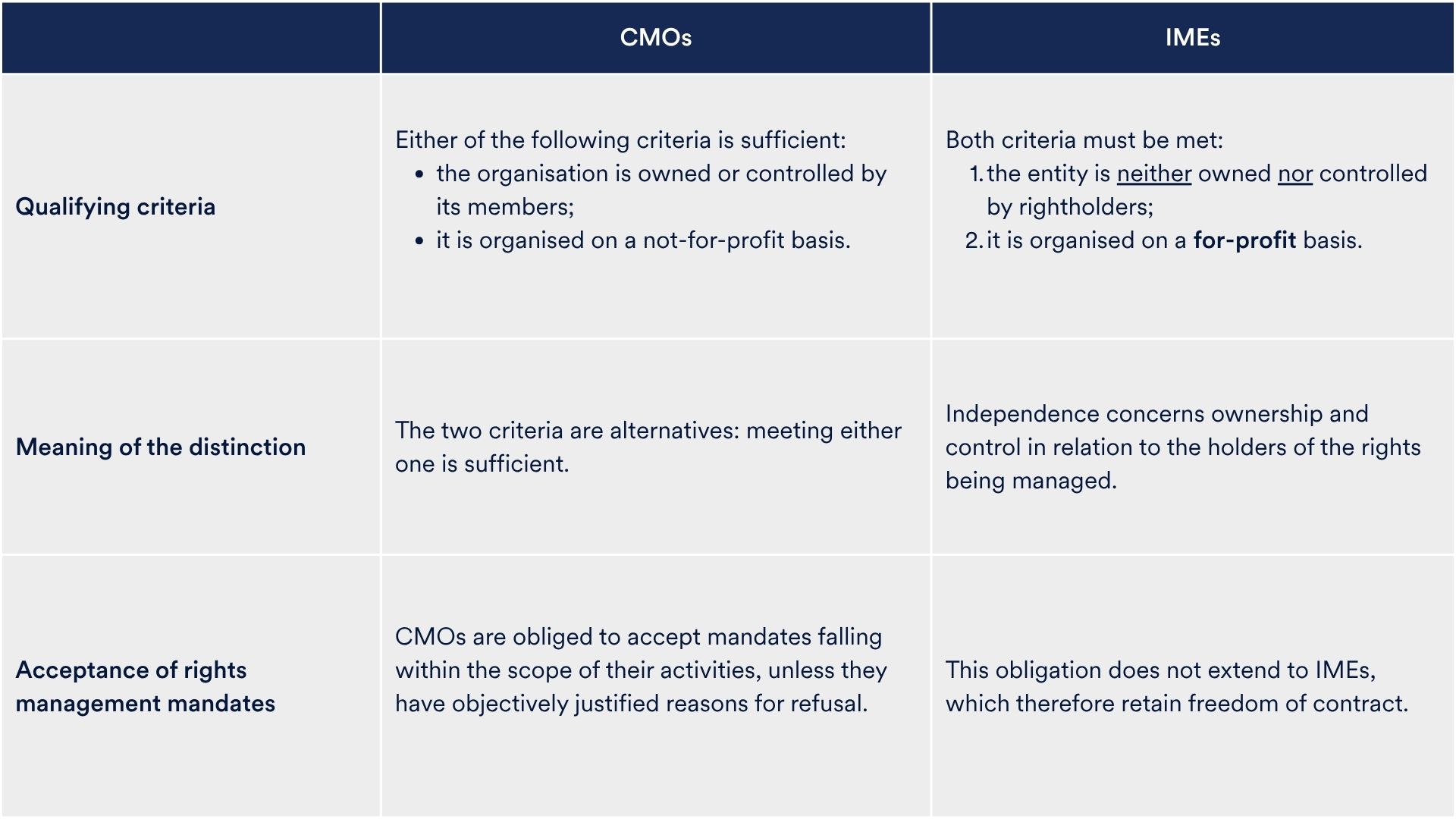
Accordingly, not all CMOs necessarily operate on a not-for-profit basis: a for-profit entity may also qualify as a CMO if it meets the criterion of control by its members.
By way of example, Liberi Editori e Autori (“LEA”)—which was also a party to LEA v Jamendo—is among the CMOs that have operated in the Italian market. An example of an IME is Soundreef Ltd, a long-established company representing more than 48,000 authors, composers and publishers, including Gigi d’Alessio.
2017 and the initial opening of the Italian market
Legislative Decree No 35 of 15 March 2017 transposed the Barnier Directive, recognising both categories of intermediaries: CMOs and IMEs. The original wording of Article 4(2) affirmed the freedom to choose an intermediary, but expressly preserved the application of Article 180 of the Italian Copyright Act (Law No 633 of 22 April 1941).
The first departure from SIAE’s exclusive position came with Article 19 of Decree-Law No 148 of 16 October 2017, converted into law by Law No 172 of 4 December 2017. Article 180 of the Copyright Act was amended to include other CMOs: SIAE’s monopoly began to “waver”. IMEs, however, remained barred from the reserved sector. This framework, which already allowed multiple operators but remained selective as to the type of intermediary admitted, formed the backdrop to what can rightly be regarded as a landmark judgment in this field.
The dispute in LEA v. Jamendo
SIAE was not directly involved in the litigation, but its outcome — as explained below — would have a significant impact on the former monopolist. LEA was an Italian CMO, whereas Jamendo SA was, and remains, a Luxembourg company qualifying as an IME. The claimant had asked the Tribunale ordinario di Roma to order Jamendo to cease providing copyright management services in Italy, relying on the statutory reservation under Article 180 of the Copyright Act as then in force. By an order of 5 January 2022, the court referred the question of whether that exclusion was compatible with EU law to the Court of Justice of the European Union (“CJEU”).
The case illustrates the only partially “liberalising” effect of the Italian provision then in force. While allowing several CMOs to operate had introduced an initial degree of competition, it had not resolved the issue of IMEs’ access to the copyright intermediation market. The dispute therefore concerned the compatibility of the national legislation with EU law insofar as it appeared to exclude an entire category of operators established in another Member State.
The CJEU’s judgment and the requirement of proportionality
In its judgment of 21 March 2024, the Fifth Chamber interpreted Article 56 TFEU, read in conjunction with the Barnier Directive, as precluding legislation that generally and absolutely prevents IMEs from providing copyright management services in a Member State other than the one in which they are incorporated. The judgment must therefore also be understood as resting on the freedom to provide services enshrined in the Treaty itself.
The protection of intellectual property may, in principle, justify restrictions. However, an absolute prohibition on operating cannot be justified where specific, less restrictive rules can achieve the same objective. The inherent differences between CMOs and IMEs may justify different regulatory treatment, but they are not sufficient to legitimise the blanket exclusion of IMEs from the market.
The judgment remains a preliminary ruling: the CJEU interpreted EU law, and the national court must resolve the dispute in accordance with that interpretation. The European Union’s Court did not simply annul Article 180 of the Copyright Act. Nevertheless, a response from the Italian legislature was expected.
Decree-Law No 131/2024 and market access for IMEs
The legislative response came with Article 15 of Decree-Law No 131 of 16 September 2024, subsequently converted, with amendments, into Law No 166 of 14 November 2024. The provision also forms part of the response to infringement procedure 2017/4092, initiated by the European Commission against Italy for incorrectly implementing the Barnier Directive, specifically by excluding IMEs from providing copyright intermediation services.
The amendment added IMEs to the intermediaries already covered by Article 180 of the Copyright Act, alongside SIAE and other CMOs. The current wording provides that “Intermediation activities, however carried out […] are reserved exclusively to the Società Italiana degli Autori ed Editori, other collective management organisations and independent management entities referred to in Legislative Decree No 35 of 15 March 2017”.
The reform combines market access with new safeguards. It:
- extends specific provisions of Legislative Decree No 35/2017 to IMEs;
- provides for AGCOM to verify compliance with the applicable requirements, including by operators established in the European Union that operate in Italy;
- requires information on their for-profit status, how collected revenue is distributed and any conflicts of interest;
- introduces separate accounting for intermediation activities and obligations to search for rightholders who have not been identified or located.
AGCOM's initial measures
One of AGCOM’s first measures in this area dates from 30 April 2025, when the Authority approved the commencement of operations by Jamendo — the company involved in the CJEU case discussed above — subject to its submission of the necessary updated documentation. Subsequently, after establishing that Jamendo had failed to comply with the requirements imposed, the Authority issued a further decision “blocking” the company’s operations in Italy.
This is fully consistent with Legislative Decree No 35/2017, which assigned supervisory and sanctioning powers to AGCOM. The Authority is responsible for receiving certified notices of commencement of activity (Segnalazioni Certificate di Inizio Attività, “SCIA”) from CMOs and IMEs. Following submission, it verifies compliance with the statutory requirements and monitors any corrective measures required.
What changes in practice for authors?
Authors now have a wider choice of organisations to which they can entrust the management of their rights: alongside SIAE and other CMOs, they can choose IMEs that meet the statutory requirements for operating.
That choice may concern specific rights, categories of rights, types of works and territories, within the scope of the intermediary’s activities and subject to existing mandates. When comparing providers, authors should therefore consider fees and other deductions, their ability to collect revenue in Italy and abroad, payment times and the clarity of their statements.
Authors choosing an IME must also be able to obtain information about its for-profit status, any differentiated distribution criteria and activities that may give rise to conflicts of interest.
Furthermore, switching from one intermediary to another requires checking the scope and effectiveness of the termination of the previous mandate, complying with the applicable notice periods and avoiding incompatible overlaps.
One fundamental difference between the two types of intermediary remains: IMEs are not subject to the general obligation, applicable to CMOs, to accept the management of rights unless there are objectively justified reasons for refusal.
Liberalisation therefore undoubtedly offers more alternatives, which authors will need to assess carefully, potentially with the assistance of copyright specialists. The potential benefits will depend on the terms of the service and how effectively it serves each author’s repertoire.
Reviewed by: Daniele Camaiora
Publication date: 17 November 2026
© Canella Camaiora S.t.A. S.r.l. - All rights reserved.
Textual reproduction of the article is permitted, even for commercial purposes, within the limit of 15% of its entirety, provided that the source is clearly indicated. In the case of online reproduction, a link to the original article must be included. Unauthorised reproduction or paraphrasing without indication of source will be prosecuted.