
Abstract
Judgment No. 51/2026 of the Constitutional Court clarifies the regime applicable to works of art “below threshold” in international circulation. The Court does not eliminate the EUR 13,500 threshold provided for by the Cultural Heritage Code, but distinguishes its effects. The threshold remains legitimate in limiting the State’s compulsory purchase power, provided for by Article 70 of Legislative Decree No. 42 of 22 January 2004, because it is a power that has a particularly significant impact on private property. It is, however, constitutionally unlawful insofar as it prevented the entry certification under Article 72 for works temporarily imported into Italy.
The decision thus reinforces the distinction between works stably present in the national territory and foreign works in transit, with significant effects for collectors, galleries, auction houses, restorers, transporters and art market operators.
The case: a foreign work temporarily enters Italy. But what is entry certification?
A work of art purchased abroad may temporarily enter Italy in order to be studied, restored, exhibited, sold or simply transported. The problem arises when, after this passage, the owner wishes to take it out of the national territory again.
This is where Judgment No. 51/2026 of the Constitutional Court begins.
The case concerned an eighteenth-century painting, purchased in Germany by a foreign company and introduced into Italy for technical analyses preparatory to a possible restoration. The work was by a deceased artist, dated back more than seventy years and had a value below EUR 13,500. It was precisely this economic element that brought the issue to light.
Under the system examined by the Court, the threshold of EUR 13,500 served to distinguish two regimes for exit from the national territory. Ancient works above the threshold were subject to prior authorisation, through the certificate of free circulation provided for by Article 68 of the Cultural Heritage Code. Works in the same category, but below the threshold, could instead leave with a self-declaration by the interested party, under the simplified regime laid down in Article 65, paragraphs 4 and 4-bis.
This scheme, however, primarily concerns works stably present in Italy. In the case decided by the Court, the work had not been purchased in Italy and was not intended to remain in the national territory. It had been bought abroad and had entered Italy only for a temporary technical need.
This is where entry certification comes into play.
Entry certification, provided for by Article 72 of the Cultural Heritage Code, serves to document that an object has arrived in Italy from another Member State of the European Union or from a third country. The certificate is issued, upon application, by the export office on the basis of suitable documents identifying the work and proving its foreign provenance.
Its function is practical. When the work later has to leave Italy again, the administration will not be called upon to reassess freely its cultural interest. It will essentially have to verify that the work leaving is the same as the work that entered. This is a check of correspondence, not a new assessment of the cultural value of the object.
In other words, entry certification serves to prevent a work coming from abroad, and entering only for a temporary passage, from being treated as if it were stably present in Italy. It is a legal trace of transit.
Without that certificate, passage through Italy may become risky. The foreign work, even if it entered for analysis, restoration or movement, may be drawn into the Italian protection regime. In the case at hand, in fact, the Ministry had ordered the compulsory purchase of the work, even though it was a below-threshold object; the Regional Administrative Court of Lazio considered the ground of appeal against that measure to be well founded, precisely because Article 70 links compulsory purchase to works for which a certificate of free circulation is required.
The constitutional issue arose from this overlap. On the one hand, it was necessary to understand whether it was legitimate to exclude works under EUR 13,500 from compulsory purchase. On the other hand, it was necessary to establish whether it was reasonable to deny those same works, when coming from abroad and temporarily imported, entry certification.
The Court answers by distinguishing the two levels. The threshold remains coherent when it limits a very intrusive public power, such as compulsory purchase. It becomes unreasonable, however, when it prevents the simple temporary entry of a foreign work from being documented.
Judgment No. 51/2026 must be read within the legislative system then submitted to the Court, built around the EUR 13,500 threshold. After that decision, Law No. 40/2026 amended the Cultural Heritage Code, raising the threshold to EUR 50,000 for many works by deceased artists and more than seventy years old, and expanding entry certification under Article 72.
This does not empty the judgment of meaning. If anything, it confirms its central point: the economic threshold may serve to make controls more selective, but it cannot transform the temporary transit of a foreign work into a risk of unjustified subjection to Italian law.
The point, therefore, is not only the economic value of the work. It is necessary to understand what function that threshold performs: a limit on a State power or an obstacle to the temporary circulation of foreign works. It is precisely from this distinction that the second step of the judgment can be understood: compulsory purchase.
Compulsory purchase: when the State may retain a work of art
The second legal instrument examined by the Court is compulsory purchase.
Compulsory purchase is governed by Article 70 of Legislative Decree No. 42 of 22 January 2004. It is the power that allows the State to purchase an object for which a certificate of free circulation has been requested, thereby preventing it from leaving the national territory.
This is not an ordinary purchase. It is an authoritative power, exercised within the export procedure.
Article 70 in fact links compulsory purchase to objects for which a certificate of free circulation is required. In turn, the certificate of free circulation is provided for by Article 68 for works subject to the authorised-exit regime under Article 65, paragraph 3.
Under the system examined by the Court, for works by deceased artists, executed more than seventy years ago, this regime applied only if the value exceeded EUR 13,500. Consequently, compulsory purchase was provided for ancient works above the threshold, not for those below it.
The Regional Administrative Court of Lazio had doubted the legitimacy of this exclusion. The reasoning was understandable: if a work under EUR 13,500 may nevertheless have cultural interest, why prevent the State from purchasing it compulsorily in order to retain it in Italy?
The Constitutional Court rejects this objection.
The reason is technical, but clear. Compulsory purchase affects private property more radically than a mere declaration of cultural interest. The Court qualifies it as “a peculiar expropriatory act”, which may be adopted in the context of the export of objects stably present in Italy.
Precisely because of this impact, the legislative choice to limit it to works above EUR 13,500 is not unreasonable. In this case, the threshold does not serve to say that below-threshold works have no cultural value. Rather, it serves to delimit the use of a public power that entails the acquisition of the object into the public heritage.
The point is important: the economic threshold does not coincide with the cultural value of the work.
The Court in fact recalls that even a work worth less than EUR 13,500 may be declared cultural property, if it meets the substantive requirements laid down in Article 10, paragraph 3, of Legislative Decree No. 42 of 22 January 2004, through the procedure referred to in Article 13 of the same Code.
Moreover, where the object has already been declared cultural property, the administration retains the expropriation power provided for by Article 95 of Legislative Decree No. 42 of 22 January 2004, if this responds to an important interest in improving the conditions of its protection for the purposes of public enjoyment.
Therefore, exclusion from compulsory purchase does not leave below-threshold works without protection. It only means that, for those works, protection must operate through the other instruments provided for by the Code, not through the special mechanism under Article 70.
The Court thus reads the EUR 13,500 threshold as the result of a balancing exercise between protection of cultural heritage, the good functioning of the administration, property rights and freedom of economic initiative. In this context, the threshold is constitutionally legitimate.
The same threshold, however, takes on a different meaning when it does not limit compulsory purchase, but prevents the temporary entry of a foreign work from being certified. It is precisely on this second level that the Court reaches the opposite conclusion.
The Decision of the Constitutional Court: the threshold remains for compulsory purchase, but falls for entry certification
Judgment No. 51/2026 does not eliminate the EUR 13,500 threshold.
It does something more precise: it assesses that threshold according to the function of the legal instrument to which it is applied.
For compulsory purchase, the threshold is legitimate because it limits a State power that directly affects private property. For entry certification, by contrast, the same threshold is unreasonable, because it prevents a foreign work in transit from documenting its temporary entry into Italy.
This is the central distinction in the judgment.
Compulsory purchase serves to retain the work in Italy, by acquiring it into the public heritage. Entry certification, by contrast, serves to do the opposite: it makes it possible to prove that the work comes from abroad and that its presence in Italy is only temporary.
The Court clarifies that the certificate allows the subsequent exit of the work through a simplified procedure. The administration does not have to reassess the cultural interest of the object from scratch. It must verify that the work leaving is the same as the work that entered. It is therefore an identity check, not a new discretionary assessment.
This passage is important for those who move works of art between different countries.
Entry certification distinguishes works temporarily introduced into Italy from works stably present in the national territory. Without this distinction, a work arriving from abroad for restoration, a fair, a sale or a technical evaluation risks being treated as if it permanently belonged to the Italian circuit.
This is where the EUR 13,500 threshold becomes problematic.
Before the judgment, ancient works above the threshold could obtain entry certification. Ancient works below the threshold, by contrast, were excluded from it. For the Court, this difference lacks reasonable justification.
Indeed, works of lower economic value are often those that circulate more frequently. They may be moved for the owner’s personal needs, for sales, restorations, expert opinions, fairs or other art-market operations. Precisely for this reason, they need clear rules on re-export.
Denying certification to below-threshold works therefore produced a disproportionate effect. On the one hand, it made international circulation more uncertain. On the other, it restricted property rights and freedom of economic initiative, protected by Articles 41 and 42 of the Constitution.
The Court intervenes with an additive ruling. It declares Article 72, paragraph 1, of Legislative Decree No. 42 of 22 January 2004 constitutionally unlawful insofar as it did not provide for certification, upon application, for the works indicated in Article 65, paragraph 4, letter b): namely, objects that present cultural interest, are by an artist who is no longer living, date back more than seventy years and have a value below EUR 13,500.
The decision does not stop there.
Consequentially, the Court extends the declaration also to the works indicated in Article 65, paragraph 4, letter a), namely paintings, sculptures, graphic works and other art objects by living artists or executed less than seventy years ago. For these works too, it must be possible to certify temporary entry into Italy.
The reason is consistent: if the work arrives from abroad only for a temporary passage, the system must be able to document that fact. What matters is not only economic value. What matters is the relationship between the work and Italian territory.
The judgment, therefore, does not reduce the protection of cultural heritage. Rather, it prevents the temporary transit of a foreign work from being confused with stable presence in Italy.
This principle was subsequently strengthened by Law No. 40/2026, which amended Article 72 of the Cultural Heritage Code by expanding the scope of entry certification.
The operational point is simple: the economic threshold may select controls, but it cannot prevent the international transit of a work from being documented.
It is precisely from this distinction that the practical effects of the judgment derive for collectors, galleries, auction houses, restorers and transporters.
What changes after Judgment No. 51/2026
After Judgment No. 51/2026, the EUR 13,500 threshold does not disappear.
It continues to matter for compulsory purchase, under the system examined by the Court. However, it cannot be used to prevent the entry certification of temporarily imported works.
The practical difference is this: one thing is a work stably present in Italy; another is a work purchased, shipped or imported from abroad and arrived in Italy only for a temporary passage.
For works stably present in Italy, the administration retains the ordinary protection tools. It may assess the cultural interest of the object, refuse the certificate of free circulation in the cases provided for by the Code and, where the conditions are met, initiate procedures for declaration of cultural interest or expropriation.
For foreign works in transit, by contrast, the issue is different. The question is not only: “can the work leave Italy?”. The first question becomes: “can I prove that this work entered from abroad only temporarily?”
This is where entry certification becomes essential.
A gallery bringing a work to Italy for a fair, an auction house receiving an object for sale, a restorer working on a painting coming from abroad or a collector temporarily depositing a work in Italy all have the same interest: to avoid the passage through Italian territory being confused with stable presence.
After the judgment, below-threshold works of art may also obtain, upon application, the entry certificate provided for by Article 72 of the Cultural Heritage Code, where the conditions indicated by the Court are met. The same applies to recent works referred to in Article 65, paragraph 4, letter a), as a result of the consequential declaration.
This does not mean that the work is removed from any control. It means that its temporary entry is documented as such.
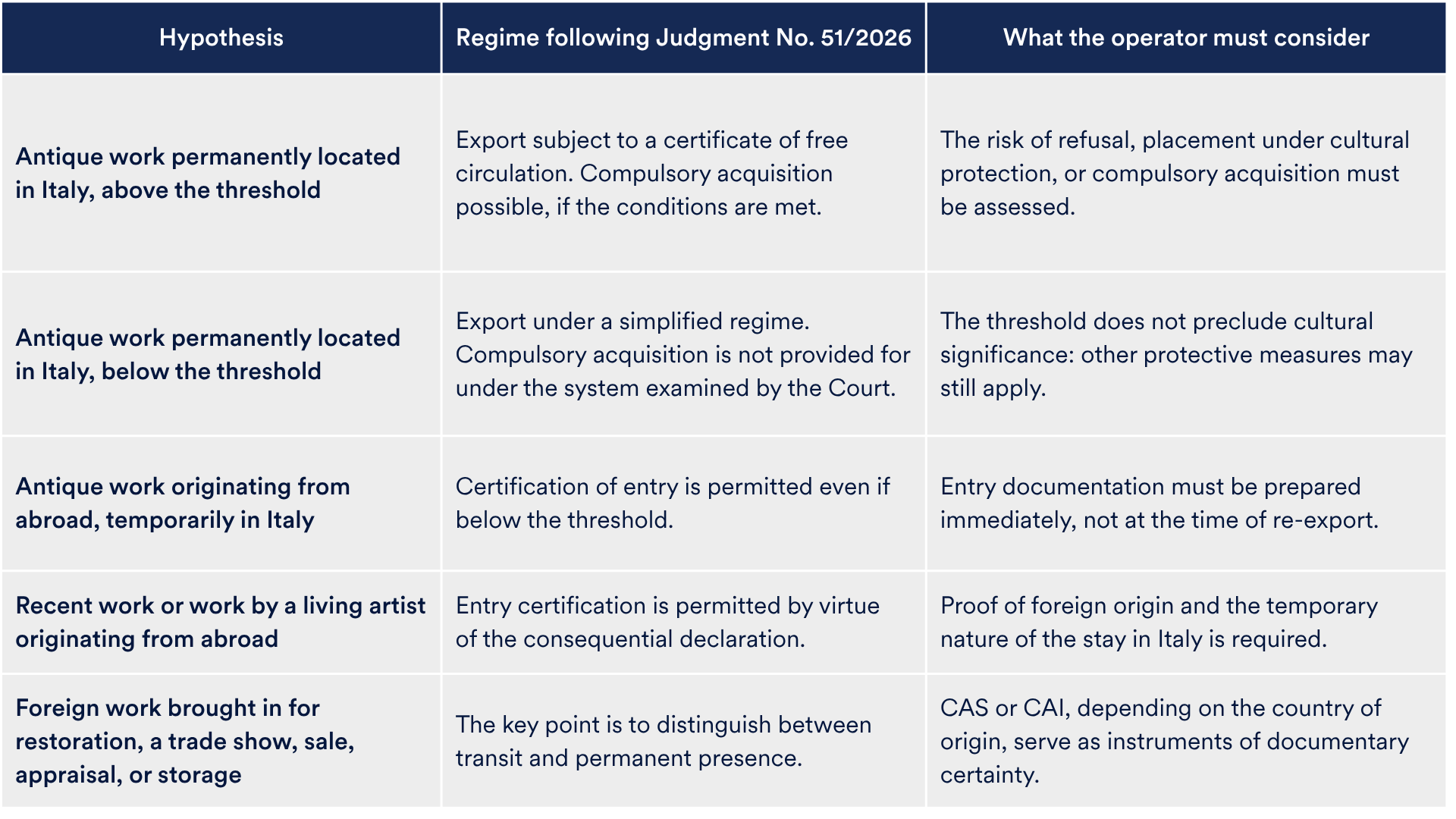
To orient oneself, it may be useful to distinguish the main operational scenarios:
Is entry certification needed to re-export a work of art?
Not always in an absolute sense. But if the work comes from abroad and must leave Italy again, the certification helps clarify its position. It makes it possible to link the subsequent exit to the documented entry and reduces the risk that the work will be treated as stably present in the national territory.
Can a work under EUR 13,500 have cultural interest?
Yes. The judgment does not say that below-threshold works lack cultural value. It says something different: economic value may affect the type of procedure applicable, but it does not exhaust the assessment of cultural interest.
Can the State still protect a below-threshold work?
Yes. The Court clarifies that ordinary protection tools remain available, such as the declaration of cultural interest, where the requirements provided for by the Code are met. What remains excluded, under the system examined by the Court, is the use of compulsory purchase under Article 70 for works that do not require a certificate of free circulation.
What should an operator do before bringing a work into Italy?
The operator must think about documentation from the moment of entry. Provenance, identification of the work, transport documents, title of purchase or availability, and the request for certification are not formal details. They are the elements that make it possible to prove, at the time of subsequent exit, that the work was in Italy only temporarily.
Law No. 40/2026 then moves in the same direction. The reform amended Article 72 of the Code, expanding the scope of entry certification, and raised the threshold to EUR 50,000 for many works by deceased artists and more than seventy years old. For this reason, today the issue must be read together with the new rules on the international circulation of works of art after Law No. 40/2026.
Judgment No. 51/2026 nevertheless remains the step that clarifies the principle: the economic threshold may serve to select controls, but it cannot prevent the temporary transit of a foreign work from being documented.
In practice, the difference is often made before re-export. If the entry of the work is properly documented, the subsequent exit from Italy rests on a more solid basis. If, instead, the entry remains ambiguous, the temporary passage may be read as stable presence in the national territory.
Judgment No. 51/2026 intervenes precisely on this point: it does not eliminate controls, but prevents the absence of certification from turning the transit of a foreign work into an issue of domestic protection.
Reviewed by: Arlo Canella
Publication date: 25 June 2026
© Canella Camaiora S.t.A. S.r.l. - All rights reserved.
Textual reproduction of the article is permitted, even for commercial purposes, within the limit of 15% of its entirety, provided that the source is clearly indicated. In the case of online reproduction, a link to the original article must be included. Unauthorised reproduction or paraphrasing without indication of source will be prosecuted.