Abstract
The decision of the Second Board of Appeal of EUIPO of 28 October 2024 (R 740/2024-2) addresses an increasingly relevant issue for businesses: can the movement of a product be registered as a trademark?
The case concerns the opening and closing sequence of a vehicle window. The Board refused registration by applying two distinct grounds for refusal under Article 7 of Regulation (EU) 2017/1001: the prohibition on protecting characteristics necessary to obtain a technical result and the lack of distinctive character.
The decision clarifies that a trademark cannot turn into a monopoly over technical solutions and that merely representing the way a product functions is not sufficient to fulfill a distinctive function. The analysis follows the framework of Common Practice CP11 on motion trademarks and provides operational guidance for structuring an effective protection strategy for dynamic signs.
The movement of a window as a trademark? Case R 740/2024-2
Motion trademarks were introduced into the European system in 2017. They differ from traditional signs because they incorporate a dynamic element that unfolds over time, through animations or changes in the position of the elements composing the sign. However, their function remains the same as any trademark: to indicate the commercial origin of goods or services.
With its decision of 28 October 2024 (R 740/2024-2), the EUIPO Board of Appeal addressed a concrete question: can the way a window opens and closes be registered as a motion trademark?
The sign applied for consisted of a six-second video reproducing the opening and closing of a window for transport vehicles (Class 12 of the Nice Classification). The sequence showed the sash opening outward and then returning to the closed position.
At first instance, the EUIPO examiner rejected the application. According to the Office, what was being claimed for protection was merely the way the product functions. Article 7(1)(e)(ii) of Regulation (EU) 2017/1001 was therefore applied, which prohibits registration of signs consisting exclusively of characteristics necessary to obtain a technical result: in this case, the movement coincided with the window’s inherent function, namely opening and closing.
In addition, the examiner held that the video was not capable of performing the distinctive function of a trademark and, pursuant to Article 7(1)(b) EUTMR, considered it devoid of distinctive character because it would not be perceived as an indication of commercial origin.
The issue thus revolved around two aspects: the prohibition on obtaining exclusive rights over functional product characteristics and the requirement that the sign be perceived as an indication of origin, rather than as a technical demonstration. It is from this technical functionality that the Board of Appeal’s reasoning begins.
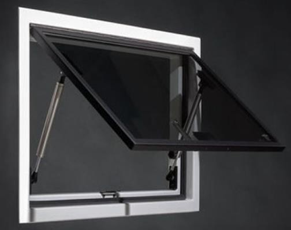
Fonte: EUIPO, Seconda Camera di ricorso, decisione 28 ottobre 2024, R 740/2024-2 – BEWEGUNG VON EINEM KLAPPFENSTER, p. 4.
The limits of trademark protection under EU Law: technical function as an obstacle
Registration of a European Union trademark is governed by Regulation (EU) 2017/1001 (EUTMR), which establishes the requirements for protection. The decision of the Board of Appeal must be understood within this framework.
Among the central provisions is Article 7 EUTMR, which lists the so-called absolute grounds for refusal. These operate independently of the existence of earlier trademarks and ensure the proper functioning of the trademark system.
- In particular, article 7(1)(e)(ii) EUTMR excludes from registration signs consisting exclusively of the shape or another characteristic of goods necessary to obtain a technical result. The rule prevents trademark law from being used to secure exclusivity over technical solutions that must remain available to market operators.
- Alongside this limitation, article 7(1)(b) EUTMR prohibits registration of signs lacking distinctive character. A trademark is protectable only if it is capable of indicating the commercial origin of goods or services and distinguishing them from those of other undertakings.
A further reference is article 9(2) EUTMR which defines the scope of the rights conferred by a registered trademark. The proprietor may prohibit third parties from using identical or similar signs under certain conditions. Precisely because protection is broad, the preliminary verification of the requirements for registrability takes on concrete practical significance.
In the case examined, these three provisions become the benchmark for assessing whether a sequence of movement can be regarded as a valid distinctive sign, or whether it merely coincides with the product’s technical function.
Necessary movement as an obstacle in trademark law
The decision examines the sign on two distinct and autonomous levels: technical function and distinctiveness.
The Board recalls that, pursuant to article 7(1)(e)(ii) EUTMR, signs consisting exclusively of a characteristic of the product necessary to obtain a technical result cannot be registered.
The principle is expressed in clear terms:
“The legal objective … is to prevent trademark protection from granting its proprietor a monopoly on technical solutions or functional characteristics of a product”. (§ 11)
The risk had already been clarified by the Court of Justice in Philips/Remington (C-299/99) and Lego (C-48/09 P): trademark law must not become a means of indefinitely extending time-limited technical rights.
In the present case, the Board observed:
“The movement applied for merely shows how the window opens and closes. The trademark application contains no further elements”. (§ 25)
The consequence was logical: the sign consisted exclusively of a representation of the product’s mode of operation.
The Board also clarified that the existence of alternative technical solutions is irrelevant:
“It is not necessary that the characteristic in question be the only possible feature capable of achieving that result”. (§ 31)
Even if other opening systems exist, the movement shown was technically causal and sufficient to achieve the result. That alone triggered the prohibition.
The assessment is objective:
“The characteristics of the sign must be determined purely objectively, on the basis of its representation”. (§ 14)
It does not matter whether the movement is unusual on the market. What matters is that it is functional.
The Board nonetheless addressed distinctiveness under Article 7(1)(b) EUTMR. The essential function of a trademark is to:
“identify the product or service as originating from a particular undertaking and thus to distinguish that product or service from those of other undertakings”. (§ 35)
Even considering a specialized and attentive public (§ 39), the conclusion was clear:
“The public … will not perceive this sign as an indication of origin, but rather as a representation and reproduction of an essential mode of operation of the window” (§ 40)
The Board added:
“It is generally known that many manufacturers of technical goods produce videos … in order to explain the functionality of the product”. (§ 41)
In this context, a sequence showing opening and closing would be perceived as a technical demonstration, not as a trademark.
A decisive clarification concerned originality:
“Novelty or originality are not relevant criteria for assessing the distinctive character of a trademark”. (§ 44)
Trademark law does not protect technical innovation as such.
Finally, the sign must be assessed “in the form submitted” (§ 47). In that form, the sequence conveyed no indication of commercial origin.
The decision demonstrates that when a motion trademark concerns a technical product, two converging obstacles may arise:
- if the sign coincides with the product’s functioning, it is excluded for technical functionality;
- if it merely shows how the product works, it lacks distinctiveness.
Together, these two levels clarify a systemic principle: a trademark is not the instrument to protect technology, nor to monopolize operational modes of a product.
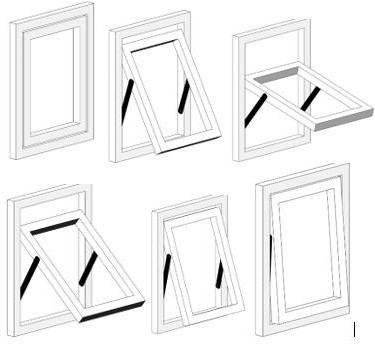
Fonte: EUIPO, Seconda Camera di ricorso, decisione 28 ottobre 2024, R 740/2024-2 – BEWEGUNG VON EINEM KLAPPFENSTER, p. 8.
CP11 and protection strategies: what companies must consider
The decision fits within the framework of Common Practice CP11 of the European Intellectual Property Network, dedicated to new types of trademarks, including motion trademarks.
CP11 reiterates a fundamental principle: non-traditional trademarks are subject to the same criteria as traditional signs. There is no relaxed regime for video sequences, animations, or movements.
In particular, it clarifies that a movement will be considered non-distinctive when perceived as a functional element of the product or as a necessary mode of its use. Likewise, the limitations of Article 7(1)(e) apply where the sign coincides with a technically necessary characteristic.
The window case represents a straightforward application of these principles:
- the movement was entirely determined by the product’s technical function;
- the sequence, as filed, conveyed no autonomous commercial origin.
For companies seeking to register a motion trademark relating to a technical product, the assessment must be preliminary and structured.
They must ask:
- Is the movement imposed by the product’s function?
- Are there non-functional, relevant, and autonomous elements capable of conferring inherent distinctiveness?
- Does the sequence communicate something beyond operational demonstration?
If the sign merely shows how the product works, trademark law is not the appropriate tool. Protection should instead be considered under other industrial property rights, such as patents or designs, which follow a different logic and are limited in duration.
CP11 and the case law cited by the Board converge on one point: trademark law protects the sign, not the technology.
Understanding this boundary is not a theoretical exercise. It is a strategic decision — and it is on this decision that the effectiveness of protection depends.
© Canella Camaiora S.t.A. S.r.l. - All rights reserved.
Publication date: 26 February 2026
Textual reproduction of the article is permitted, even for commercial purposes, within the limit of 15% of its entirety, provided that the source is clearly indicated. In the case of online reproduction, a link to the original article must be included. Unauthorised reproduction or paraphrasing without indication of source will be prosecuted.