Abstract
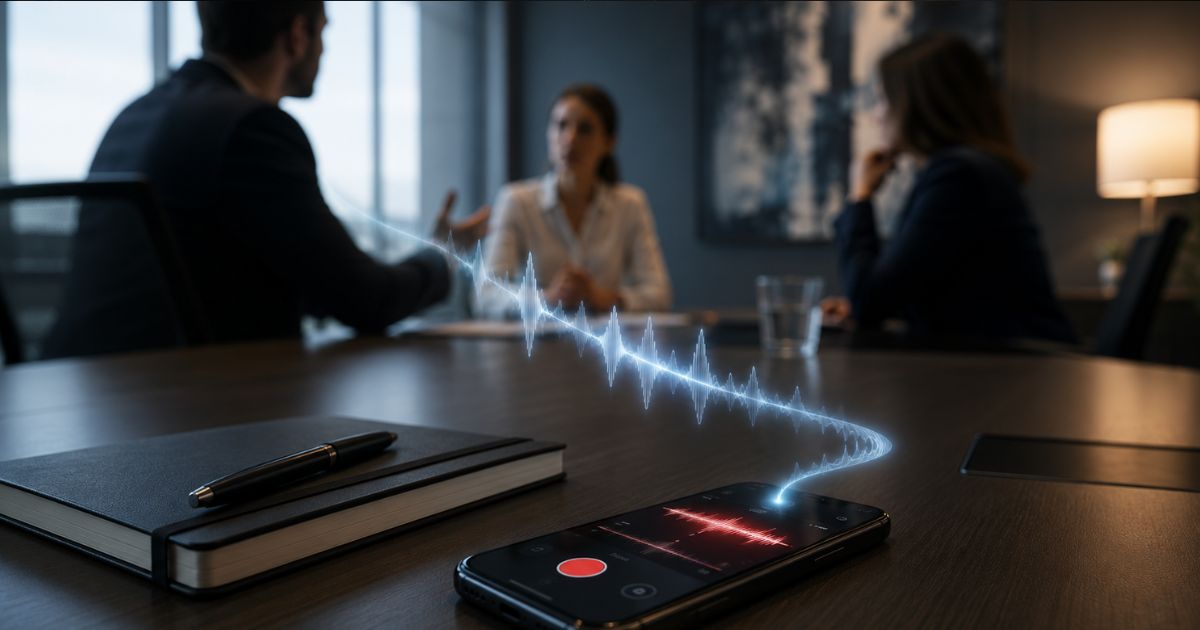
Is it lawful to record workplace conversations? May an employee record a meeting, a discussion with their manager, or a conversation with colleagues without informing them? Above all, may the employer discipline or even dismiss the employee on that ground?
The answer is less straightforward than it may appear. In assessing whether the employee’s conduct is lawful, particular weight must be given to the purpose pursued and the subsequent use of the recording. The central issue is the balancing exercise between the interlocutors’ right to privacy and the recording party’s right of defence, in respect of which the case law of the Italian Supreme Court has progressively developed increasingly well-defined criteria.
Recording, disclosure and the right of defence: the applicable rules
A preliminary distinction must first be drawn.
An audio or video recording of a conversation made by a person who is not a participant in that conversation is unlawful.
Why? Because the third party covertly and surreptitiously intrudes into another person’s communication in order to capture its content.
By contrast, a person who participates in the conversation does not obtain information extraneous to them: that person is already the intended recipient of the words spoken and merely preserves a record of them. Among several authorities, albeit in a case entirely unrelated to the employment context, the Criminal Division of the Italian Supreme Court reiterated in Judgment No. 10079/2024 that
«an audio recording of a conversation held in person or through means of communication, made by a person taking part in it or otherwise authorised to attend it, does not amount – even if made covertly – to an interception; rather, it constitutes the audio preservation of a historical event which the person making the recording may lawfully use.».
The lawfulness of making a recording must not be confused with the lawfulness – or unlawfulness – of its disclosure.
Recording a conversation in which one participates is one matter; disclosing the content of that recording to third parties, publishing it online or using it for purposes other than the protection of one’s own rights – for example, to damage the reputation of the person concerned – is quite another. Such conduct may infringe other persons’ privacy rights, breach the employee’s duties of loyalty toward the employer and, in the most serious cases, give rise to criminal liability.
The purpose of the recording is therefore central to the assessment of its lawfulness. A recording is lawful where it is made for the purpose of exercising the right of defence—including out of court and before formal proceedings have been commenced—as protected by Article 24 of the Italian Constitution.
Why, however, might an employee wish to record a conversation with colleagues or managers? In most cases, the reason is the need to obtain evidence capable of protecting the employee’s rights within the employment relationship. Typical examples include discriminatory conduct, undue pressure, workplace bullying (mobbing) or harassment.
Indeed, recordings are now generally admissible as evidence under Article 2712 of the Italian Civil Code.
When a defensive purpose makes the recording lawful
Judgments issued in recent years have progressively identified a number of assessment criteria, which may be traced back to the requirements of defensive necessity, relevance and proportionality.
In other words, the recording must be:
- connected with a specific and genuine need for defence;
- relevant to the right that the employee seeks to protect;
- limited to what is necessary to obtain the evidence.
In such circumstances, the conduct is justified by Article 51 of the Italian Criminal Code, a provision of general application throughout the legal system and not confined to criminal law matters.
Order No. 24797/2024 of the Italian Supreme Court states that
“what matters, therefore, is not how or by whom the recording was made, nor whether the person who physically made it had defensive needs, but the purposes for which the recorded conversation and the information contained in it were used and, specifically, the purpose pursued through such use.”
The Italian Supreme Court of Cassation adopted the same approach in Order No. 5844/2025, setting aside a disciplinary sanction imposed on a doctor who had recorded a workplace conversation with a colleague without that colleague’s consent. The recording had been made to obtain evidence for use in a complaint lodged against the director of the healthcare unit in relation to alleged misconduct committed against her. It was precisely because of that defensive purpose that the Supreme Court held the recording to be lawful.
The lawfulness of this “defensive use” was also confirmed by the well-known Judgment No. 28398/2022, which admitted audio evidence used to expose a retaliatory dismissal.
Order No. 20487 of 21 July 2025 reached the opposite conclusion. In that case, the Italian Supreme Court found that the recording lacked a defensive purpose because the lengthy period that had elapsed – two years from the date of the recording – together with the absence of any connection between the content of the conversation and the subject matter of the subsequent proceedings, demonstrated the merely exploratory nature of the recording.
In summary, the following conduct may have disciplinary—and potentially criminal—relevance:
- systematic and indiscriminate recordings of colleagues or managers;
- the pre-emptive collection of conversations without any specific defensive reason—for example, on the basis that “it may come in useful one day”;
- the creation of personal archives of workplace conversations;
- the disclosure of recordings to third parties or through channels not necessary for protecting the relevant right;
- the use of recordings to “steal” confidential or proprietary company information;
- recordings that have been manipulated or edited so as to distort their content.
What can the employer do?
The discovery of a recording may lead the employer to conclude that the relationship of trust with the employee has been undermined.
Before taking disciplinary action, however, the employer should consider the reasons that led the employee to make the recording.
A recording may serve as a warning sign of tensions, conflict or inappropriate conduct within the organisation or with other colleagues. If identified promptly, it may enable the employer to intervene to protect employees’ physical integrity and moral personality, as required by Article 2087 of the Italian Civil Code, and to prevent workplace distress from developing into full-scale litigation.
Before initiating disciplinary action, the employer should therefore carry out a prompt but non-intrusive investigation of the facts, gathering the available evidence while avoiding disproportionate measures or steps potentially prejudicial to the employee’s privacy, such as indiscriminate inspections of personal or company devices or demands that the employee hand over the recording.
Once the available preliminary evidence has been gathered, the employer may need to start disciplinary proceedings even though every aspect of the matter has not yet been clarified. A formal disciplinary charge does not require absolute certainty as to the facts; it is sufficient that there be evidence capable of supporting the view that the conduct may constitute a breach of the employee’s obligations.
The disciplinary charge must be in writing, timely and sufficiently specific: it should not merely refer to the fact that a recording was made, but should describe the circumstances that render the conduct incompatible with the employee’s obligations.
Through the employee’s written or oral explanations, the employer may obtain further information concerning the circumstances in which the recording was made, the purpose pursued and the use made of the material collected. For this reason, the disciplinary charge is often not only the first step in any sanctioning procedure, but also a useful means of completing the investigation of the facts.
After receiving the employee’s explanations, the employer should carefully assess:
- whether the conversation actually took place and its content;
- the manner in which the recording was obtained;
- the purpose pursued by the employee;
- whether a specific dispute existed and, therefore, whether the employee may rely on the justification afforded by the right of defence;
- the subsequent use or disclosure of the recorded material.
Where the investigation identifies conduct amounting to a disciplinary offence, the employer may consider imposing a sanction proportionate to the seriousness of the established conduct.
Less serious cases may warrant conservative disciplinary measures, whereas dismissal may also be considered in the most serious cases.
As is often the case in disciplinary matters, there are no automatic outcomes: the lawfulness of any sanction will depend on the specific circumstances and on the employer’s ability to establish the actual seriousness of the conduct alleged.
Reviewed by: Pablo Lo Monaco Dominguez
Publication date: 15 July 2026
© Canella Camaiora S.t.A. S.r.l. - All rights reserved.
Textual reproduction of the article is permitted, even for commercial purposes, within the limit of 15% of its entirety, provided that the source is clearly indicated. In the case of online reproduction, a link to the original article must be included. Unauthorised reproduction or paraphrasing without indication of source will be prosecuted.

Debora Teruggia
Graduated in Law with experience assisting companies and employees (employment law), commercial contracts and intellectual property (IP)